
Power, Blood, and Consequence
Inside the career of Ali Larijani

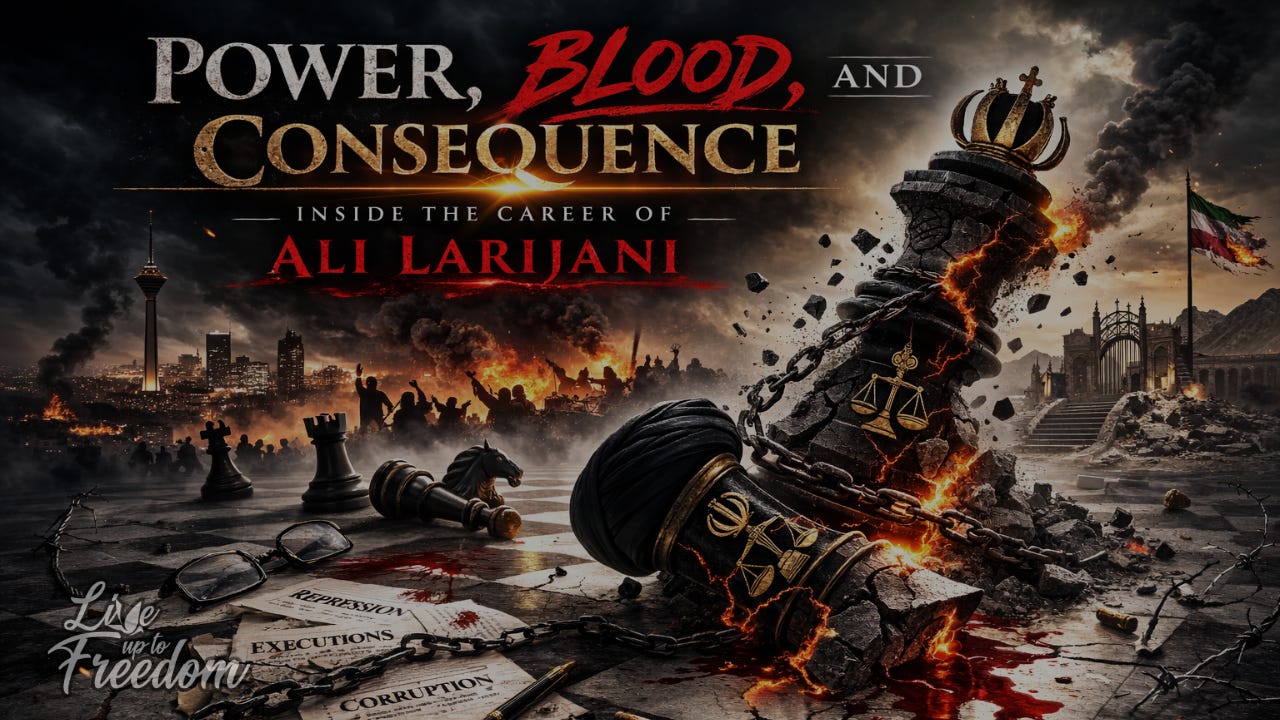
I have been telling you for years, with evidence, documentation, and a consistent pattern of behavior, that the Islamic Republic is not sustained by ideology alone but by individuals placed at critical points of control. These are not symbolic figures. These are men whose decisions translate directly into policy, enforcement, and consequences for millions.
Ali Larijani was one of those men.
To understand his role, you cannot read his résumé the way Western media presents it, as a sequence of political titles suggesting administrative responsibility. You have to understand what those positions require inside the Islamic Republic. Every role he held placed him closer to the operational core of power, where information is controlled, dissent is assessed as a threat, and responses are coordinated across security, intelligence, and political channels.
Larijani served as head of state broadcasting, a position that in Iran is not about media in the Western sense but about narrative control. This role determines what the public is allowed to see, what is suppressed, and how events are framed to maintain stability. That level of control is not passive. It requires alignment with the regime’s priorities and the discipline to enforce them consistently.
He later became Secretary of the Supreme National Security Council, where his responsibilities shifted directly to managing unrest and state response. This is where protests are evaluated, threats are defined, and decisions are made about surveillance, arrests, and force deployment. These are not abstract discussions. They result in action carried out across intelligence units, security forces, and enforcement structures.
Larijani was not observing these processes. He was positioned inside them.
As Speaker of Parliament, he became more visible, but visibility should not be mistaken for distance from power. In the Islamic Republic, legislative authority does not function independently from security enforcement. It operates within boundaries set from above and reinforced through the same structures that carry out suppression. His role at that level required continuity with the system, not separation from it.
You do not move through these positions by remaining neutral. Advancement requires reliability, alignment, and the ability to operate within the system exactly as it is designed to function.
That includes how the regime responds to dissent.
From the 2009 Green Movement to the waves of protests that followed, the Iranian people have repeatedly demonstrated that opposition to the regime is not marginal. Each time, the response followed a pattern: control of information, identification of participants, mass arrests, executions, and the use of force to restore control. These responses were coordinated, not improvised.
They occurred while figures like Larijani were positioned within the decision-making structure that enabled them.
This is where Western analysis consistently fails. It separates political roles from enforcement roles, as if one operates without the other. That distinction does not exist in the Islamic Republic. Political authority and security enforcement function together, and individuals at Larijani’s level operate within both realities.
Responsibility in such a system is not always visible in a single signature, but it is present in the structure itself. When decisions move through coordinated channels, those positioned at the center of those channels are part of the outcome.
That is what his career represents.
When discussing consequences, the focus should not be on personality but on function. Larijani’s significance was not symbolic. He operated as a connector between institutions, carrying influence, trust, and operational knowledge that allowed different parts of the regime to function in coordination.
Removing a figure like that does not immediately dismantle the system, but it does create disruption. It affects communication, slows decision-making, and introduces uncertainty among those who remain. In a structure that depends on control and continuity, that disruption matters.
For the Iranian people, especially those who have experienced loss, imprisonment, or suppression, these moments are tied to years in which accountability has not existed, and justice has not been accessible. No single event reverses that history, but it changes the perception of what is possible.
It introduces something the regime works constantly to prevent: doubt.
Doubt inside the structure. Doubt among those enforcing it. Doubt about whether the system is as untouchable as it presents itself to be.
And that is where the larger pattern becomes visible.
Regimes like this do not collapse because of a single event or individual. They weaken when pressure accumulates, when internal confidence begins to fracture, and when the individuals who hold the structure together are no longer there to maintain it.
This is not about one man.
It is about understanding the role he played, the position he held, and what it means when figures like him are no longer in place to sustain that structure.
Because power built on suppression requires constant reinforcement.
And when that reinforcement begins to weaken, the system does not remain unchanged.
With multiple senior figures removed, and growing uncertainty surrounding the Supreme Leader, the conditions that precede structural collapse are no longer theoretical. They are beginning to take shape.

If you value independent investigative work that refuses to bend, take action, upgrade to a paid subscription, or make a one-time contribution.
You can also support the mission by pre-ordering The Architecture of Jihad. Pre-orders directly fund future research, writing, and production.
May God bring success.
I wished (if not prayed), for years and years to see this epitome of arrogancy wiped from the earth. And that it was done by Israel makes me that more ecstatic. Hallelujah!
Psalm 58:10