
Auschwitz Wasn’t Built Overnight
Before the gas chambers came the lies, the laws, and the excuses

May 20, 1940
The morning air was cold and damp in German-occupied southern Poland.
Near the town of Oświęcim, dust drifted through old military barracks that still carried the smell of decades of military use. The buildings were worn, heavy, gray, and ordinary-looking.
German trucks moved in and out of the newly occupied complex, now controlled by the SS. The structures were old Austro-Hungarian and Polish military buildings; long brick barracks surrounded by fencing, guard posts, and muddy roads scarred by years of soldiers, machinery, and war preparations.
The Germans had renamed the town Auschwitz.
At the gate stood armed guards in black and gray uniforms. Paperwork moved from desk to desk inside converted administrative offices. Orders were barked in German. Supplies were unloaded. Barracks were inspected. Construction plans were already being discussed. The camp was still being organized.
Barracks needed repairs. Security systems needed expansion. Fences had to be reinforced. Roads needed work. Administrative systems had to be built from scratch.
The camp commandant, Rudolf Höss, had only recently been assigned to oversee the project. His task was clear: transform this old military complex into a functioning concentration camp for the expanding Nazi occupation system in Poland.
And from the Nazi perspective, the timing made perfect sense.
Germany had invaded Poland the previous September. Resistance activity was growing. Polish intellectuals, priests, teachers, political organizers, and suspected dissidents were already being arrested in large numbers. The SS needed more detention capacity in occupied territory, especially in areas connected to rail infrastructure.
Oświęcim was useful.
The location sat near major rail lines. The existing military buildings reduced construction costs. The area could be isolated and expanded if necessary. From a bureaucratic standpoint, it was practical.
That practicality is part of what makes the story disturbing.
People often imagine history’s darkest places as being born out of visible madness. But many of them begin inside ordinary offices; with engineers, logistics officers, architects, rail planners, administrators, supply managers, and typed memos.
A concentration camp still needs paperwork.
And by 1940, Nazi Germany had become extremely efficient at paperwork.
When Adolf Hitler became Chancellor in 1933, many Germans were exhausted, angry, and desperate for stability. The country was still struggling under the weight of economic collapse, political violence, mass unemployment, and the humiliation that followed World War I. The Nazi Party understood that desperation perfectly.
Their messaging rarely presented itself as hatred. It began with restoration.
National pride. Economic recovery. Law and order. Security. Unity.
To millions of Germans, the movement initially presented itself not as a coming dictatorship, but as a government promising stability after years of chaos.
But the language slowly changed.
Under Joseph Goebbels, newspapers, radio broadcasts, schools, films, and public messaging increasingly pushed the same themes. Germany’s problems were blamed on enemies: political enemies, ideological enemies, racial enemies, and internal enemies.
Opponents were no longer simply people with different views. They became threats to the nation itself.
That narrative changed everything.
Because once people are viewed primarily as threats, the public becomes far more willing to accept harsher measures against them.
At first, the targets were largely political: communists, union organizers, journalists, dissidents, and critics of the regime.
Early concentration camps, including Dachau concentration camp, were presented as necessary facilities to hold dangerous political elements and preserve public order.
Many Germans accepted that explanation. Others chose not to look too closely. Some openly supported the measures because they believed stability mattered more than civil liberties.
That gradual normalization became one of the foundations of the entire system. And one of the central targets of that normalization was Germany’s Jewish population.
The Nazi government increasingly blamed Jews for Germany’s economic struggles, political instability, moral decline, and national humiliation after World War I.
By the mid-1930s, anti-Jewish rhetoric had evolved into state policy and expanded dramatically across Germany. Jewish businesses were boycotted. Jewish professionals lost jobs, licenses, and access to public life. Public humiliation became increasingly common as propaganda intensified throughout the country.
Then came the Nuremberg Laws, which stripped Jews of citizenship protections and legally separated them from broader German society. What had once been social hostility was now embedded into law.
On May 20, 1940, the first prisoner transport arrived at Auschwitz.
Thirty German criminal prisoners were transferred from Sachsenhausen concentration camp. Handpicked by the camp’s first commandant, Rudolf Höss, they were assigned prisoner numbers 1 through 30 and brought to help establish the camp’s internal operation.
Before large-scale prisoner transports began arriving, these first inmates were used to help organize and expand the camp itself. Under SS supervision, they unloaded supplies, carried materials, repaired barracks, installed fencing, prepared prisoner barracks, and helped establish the camp’s internal discipline system.
Some were assigned authority over future prisoners as kapos and functionaries, creating the hierarchy the SS intended to use inside the camp structure.
Their arrival marked the beginning of Auschwitz as a functioning concentration camp.
Less than a month later, on June 14, 1940, the first large transport of 728 Polish political prisoners arrived. Many were resistance suspects, students, teachers, priests, lawyers, professors, and local political figures. The Nazis understood that controlling occupied Poland required dismantling the country’s intellectual and leadership class.
By the time the camp opened, Nazi Germany already had years of experience operating concentration camps throughout the Reich. The SS had developed systems for forced labor, surveillance, punishment, prisoner hierarchies, and mass detention.
What was taking shape in occupied Poland was not an improvised experiment. It was the expansion of an already functioning system.
Inside the camp, conditions deteriorated quickly. Barracks became overcrowded. Disease spread through poor sanitation and exhaustion. Food was minimal, medical care was almost nonexistent, and punishments were often arbitrary and brutal.
Prisoners spent long hours performing forced labor while the camp continued expanding around them. They repaired buildings, carried construction materials, installed fencing, built roads, and worked through illness, starvation, and physical abuse.
Some collapsed during construction. Others died from exhaustion, disease, executions, or brutal punishments carried out inside the camp.
New prisoners replaced them, and the work continued.
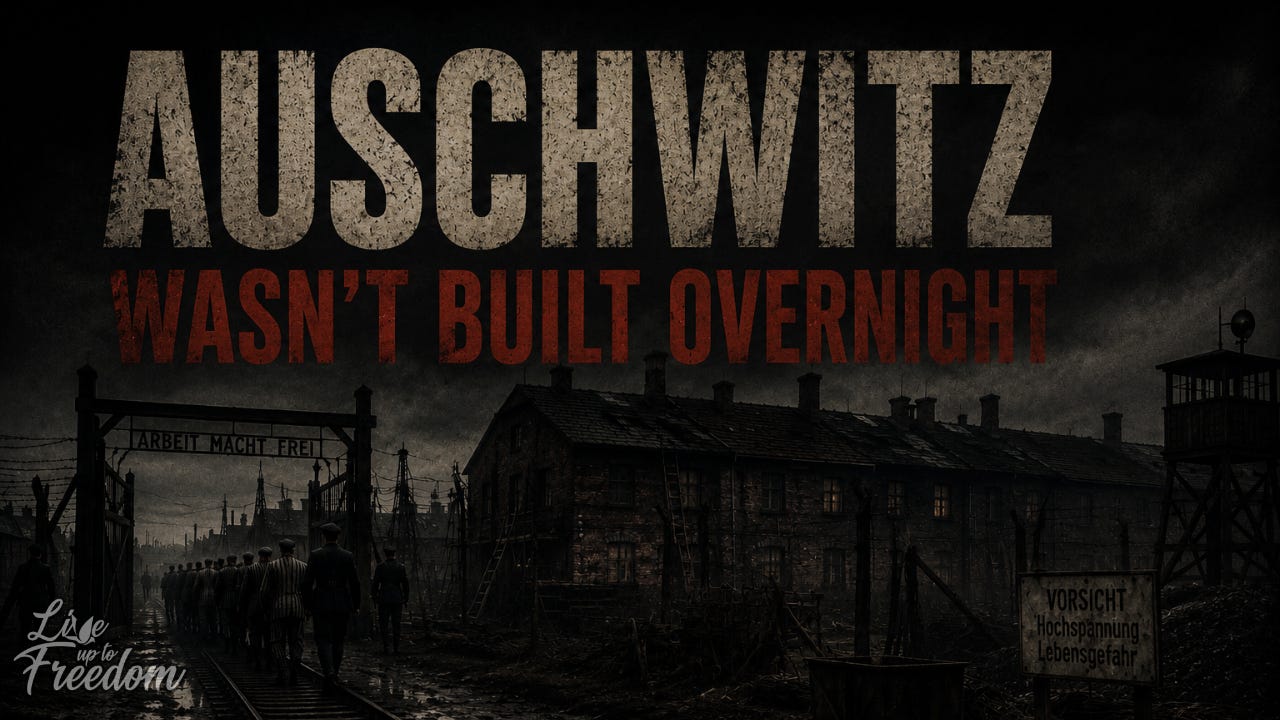
Above the camp’s main entrance hung the phrase “Arbeit Macht Frei”; “Work Sets You Free.” The slogan became one of the cruelest symbols of Nazi deception and psychological warfare. Prisoners marched beneath those words daily while enduring starvation, beatings, forced labor, executions, and systematic extermination inside the camp.
What began in May 1940 as a small concentration camp built around roughly 20 former military barracks near Oświęcim grew within five years into the largest concentration and extermination camp in Nazi Germany’s system, covering 40 square kilometers.
The Auschwitz system ultimately included Auschwitz I, the main administrative camp; Auschwitz II-Birkenau, the primary extermination center; and Auschwitz III-Monowitz, which supplied forced labor to German industrial operations, including IG Farben. More than 40 additional subcamps were later connected to the complex.
At its peak, thousands of SS personnel were assigned to Auschwitz. Historians estimate that more than 8,000 SS guards, administrators, doctors, and officers served in the camp system during its operation.
Between 1940 and January 1945, more than 1.3 million people were deported to Auschwitz. Approximately 1.1 million were murdered there; the overwhelming majority were Jews. The victims also included Poles, Roma, Soviet prisoners of war, resistance members, clergy, political prisoners, and others targeted by the Nazi regime.
When Soviet forces entered Auschwitz on January 27, 1945, they found only about 7,000 surviving prisoners still inside the camp. Most were starving, sick, dying, or too weak to move after years of forced labor, disease, medical abuse, executions, starvation, and systematic dehumanization.
What many Germans were told would restore order and protect the nation ultimately evolved into one of the deadliest killing centers in human history.
The state did not move from normal society to extermination overnight.
It moved through isolation, legal discrimination, propaganda, fear, and public conditioning; one policy, one justification, and one compromise at a time.
And with each stage, more people adapted.
Some supported it. Some benefited from it. Many stayed silent.
Outside the camps, much of the world continued living in fear, denial, distraction, or self-interest while the system expanded.
That may be one of the most uncomfortable historical truths to confront.
Not only does evil exist, but some of history’s largest systems of evil were constructed slowly while ordinary life continued around them.
Promises of stability, order, and national restoration evolved into one of the deadliest killing centers in human history.
Auschwitz was not built overnight.
It was built through laws, propaganda, bureaucracy, fear, public adaptation, and the willingness of enough people to keep adjusting to what once would have been unthinkable.
I would ask you to read this piece again and stop when the circumstances begin to feel familiar. The time to learn from history is now. Don’t wait for another May 20th, or for another Auschwitz to be under construction.
Get a copy of The Architecture of Jihad and equip yourself with the truth before the enemy overtakes you.

Your support helps keep this mission running and growing.
Whether it is a monthly contribution or a one-time gift, every bit directly fuels the work.
I have been to Auschwitz! My late husband was in the military; Army, and had 2 tours in Germany. 1 in Bindlach (near Chec border) and 2 in Zirndorf (near Nuremberg). I had read the book "Diary of a Young Girl" (Anne Frank) and "The Hiding Place" (Corrie ten Boom) plus seen the movie "The Boy in the Striped Pajamas". It took me a long time to decide to go visit cuz of the history! My emotions were all over the place .. sad, mad, disgust, horrifie, etc, etc you name it! There were many others besides Jews even Americans. You could sense the evil that had been there! You explain well how the people were deceived into accepting the camp and justified what went on there. God help us prevent it from happening again in Jesus name.
Thank you Aynaz. Another fine article. Absolutely the truth. People were asleep then until it was too late and paid the price. Today, people are asleep and even willfully ignorant to what is happening around them and it will be their demise. Too many have ignored history and too many could care less as long as their lives are doing well. People like yourself, do their part to shout from the roof tops, but people just don’t want to pay attention. We have taken our comfortable lives for granted and because of that, people think what happened in history could never happen now. When in fact, it may be just as bad or worse.
God bless♥️🇨🇦🙏🏻